
Missionary AI
Living Out Your Mission with the Help of AI


St. John Paul II (JP II) often wrote and spoke about the personal call to holiness. He emphasized that each person has a unique mission from God, not just a vocation to a state of life (married, single, religious…) but a vocation within the vocation. Whether you're married, a priest, or single, you have a specific task that only you can fulfill.
JP II reflected deeply on Genesis and the image of God within each person. But that image is not generic; it’s personal, and no one else reflects God’s goodness quite the way you do. That’s why your mission matters. Some live it out through service, others through illness and suffering. Regardless of the form, your daily work—whether you're a doctor, teacher, administrator, or accountant becomes more than a job when you offer it to others and God. It becomes a mission.
And when you see your work as a mission, you take all the help you can get. Missionaries throughout history have adapted tools from the cultures they served to carry out their calling more effectively. Similarly, modern missionaries, those who serve through their daily work, should be open to tools that can enhance their effectiveness. That includes artificial intelligence.
Here are three small ways I’ve used AI recently in my work at a Catholic school:
Creating a New Teacher Flyer in Minutes:
A new teacher asked me about our access to Canva and mentioned that it would have been helpful to see a list of school-supported apps in the binder she was given during orientation. I hadn’t known such a binder existed—my assumption had always been that teachers would refer to the digital course I created in Schoology. But her comment made me realize the value of having a quick-reference sheet in print.
I took a screenshot of the Schoology page where I had already listed all our apps and tutorials. I uploaded that screenshot to ChatGPT and asked it to list all the apps it could identify. It instantly generated a clean list. I then pasted that into a Canva Visual Doc, used Canva’s AI-powered Magic Switch to turn it into a flyer specifically designed for new high school teachers, and added the school’s branding.
In under 15 minutes, I had a polished flyer with concise app descriptions and links to relevant resources. Something that would have taken me hours to design by hand now serves a meaningful purpose: equipping teachers to serve students better.Turning Complex Data into Something Usable:
The business office asked if I could provide a spreadsheet showing which students were involved in various programs—sports, magnet programs, special services, etc., with one row per student and checkboxes or indicators across the columns.
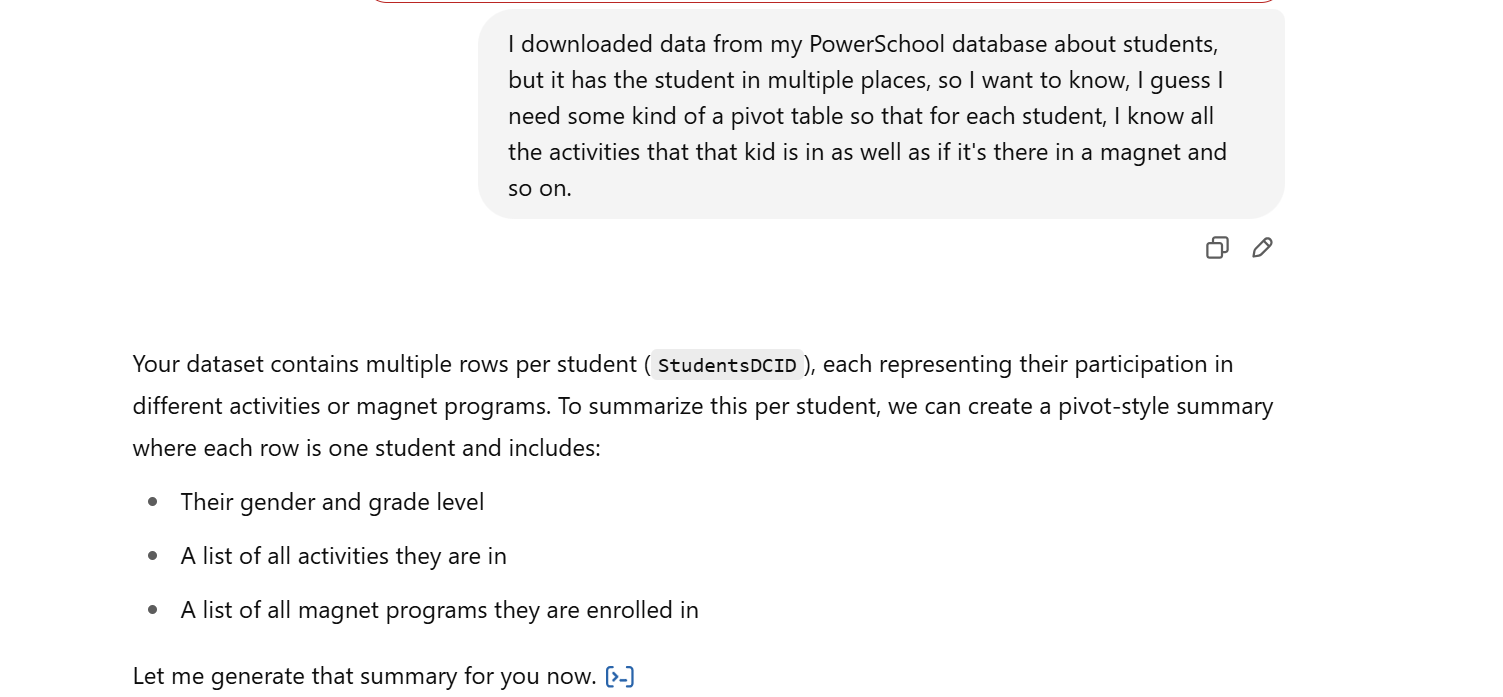
I exported the necessary fields from our database, but due to the system's data structure, each student appeared multiple times, once for each activity. Trying to fix it manually or even with a Pivot Table was daunting, especially under a time crunch.
I duplicated the spreadsheet, removed all names to protect privacy, and uploaded it to ChatGPT. Then I explained, in plain English (using the microphone feature), what I wanted, and the AI wrote the prompt. It restructured the file perfectly. Here is a screenshot of my prompt and how it interpreted my input
I downloaded the result, used a simple VLOOKUP to match names back into the cleaned file, and sent it off. It probably took me an hour in total, but it would have taken three without AI, and now I know how to do it faster next time.
Turning a PDF Guide into an Email:
I needed to show teachers how to perform a specific task in one of our school apps. The company provided PDFs, but experience taught me that attachments often go unopened. I wanted to communicate the same steps in a concise email.
I uploaded the PDF to ChatGPT and asked it to summarize the steps clearly and succinctly. After reviewing to make sure it captured everything accurately, I pasted it into an email, formatted it a bit, and sent it out. Done in minutes—and far more likely to be read.
These aren’t groundbreaking projects. They’re just real, practical tasks that needed doing, and AI made them faster and better. No special degree required.
If you believe your work is a calling, then you have a responsibility to do it well and efficiently. That doesn’t mean working harder or longer; it means working smarter, using the best tools available to serve others. Artificial intelligence is one of those tools.
You don’t need to know everything. You just need to get started. Use it with integrity, protect sensitive data, and keep your mission at the center. Because when your work is part of God’s plan, excellence isn’t optional; it’s an offering.
This reflection is both inspiring and practical. It beautifully weaves together the Catholic understanding of personal vocation with the responsible use of modern tools like AI. The examples are clear and relatable, showing how even small tasks can become meaningful when done with purpose and care. A thoughtful reminder that excellence in our work is not just professional—it’s spiritual.